

For executives of public companies, a high net worth on paper doesn't always translate to financial clarity. Here's how a cash-flow-first approach built around ISOs, NQSOs, SARs, RSUs, and executive deferred compensation changes the equation.
Most financial planning conversations start with a balance sheet: total assets, total liabilities, net worth. For executives, though, that snapshot tells only half the story, and often the less useful half.
When a meaningful portion of your compensation arrives as incentive stock options (ISOs), non-qualified stock options (NQSOs), stock appreciation rights (SARs), restricted stock units (RSUs), and executive deferred compensation, the timing and structure of those inflows matters just as much as the total dollar amount.
That's the core insight behind cash-flow-based financial planning, and it's why we build every executive strategy around it at Tempo Wealth.
The Executive Compensation Paradox
We typically hear some version of the following from senior leaders and executives: "I know I'm doing well financially and saving, but I'm not sure how everything ties together — and I'm probably not as tax-efficient as I could be." It points to a real structural gap, and it's more common than most people realize.
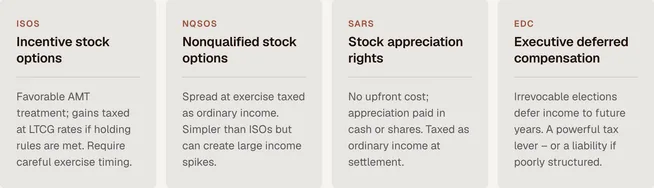
Executives are frequently accumulating wealth across multiple vehicles simultaneously, but without a coordinated plan, those vehicles don't talk to each other. ISOs can't be exercised without considering AMT exposure, for example. NQSOs create ordinary income the moment they're exercised, and SARs settle in cash or stock at the company's discretion.
Performance RSUs may vest anywhere from zero to 200% of the target grant depending on whether the company hits its metrics. An executive deferred compensation election was locked in years ago and can't be unwound. All of this creates a financial structure that a traditional budgeting model simply cannot handle.
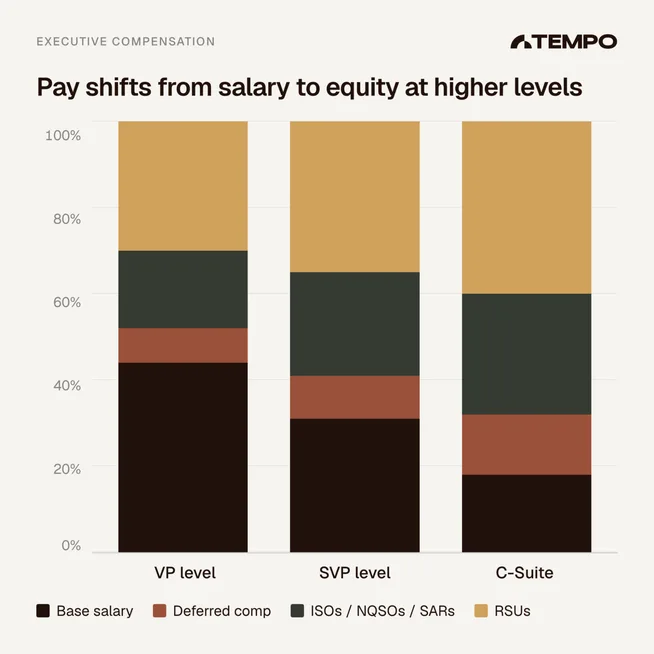
Cash-flow-based planning provides that coordination layer. Instead of asking "what is my net worth?", it asks: when does money actually move, and how do we align those flows with your tax exposure, lifestyle needs, and long-term goals?
Understanding RSUs: Not All Restricted Stock Is the Same
Restricted stock units are among the most common forms of executive equity compensation, but they're also among the most misunderstood, because "RSU" is really an umbrella term covering two very different instruments with very different planning implications.
Time-Based RSUs: Predictable, Schedule-Driven Vesting
Shares vest according to a predetermined schedule, typically over three to four years, with equal tranches releasing annually or quarterly. Once the vesting date arrives, the shares are delivered and their fair market value is taxed as ordinary income, regardless of whether you sell. The planning challenge is managing those automatic tax events in the context of your total income picture for that year.
Performance RSUs (PRSUs): Conditional Vesting Tied to Company Targets
Performance RSUs follow a similar schedule, but the number of shares that actually vest depends on whether — and how well — the company hits predefined performance targets. Payouts typically range from 0% (if targets are missed entirely) to 200% of the original grant (if the company significantly exceeds them). That range makes PRSUs the most variable and least predictable component of executive pay.
What Performance Metrics Drive PRSU Vesting?
The specific metrics that determine how many shares vest vary by company and plan design, but the most common include:
- RONAE — return on net assets employed
- EBITDA — earnings before interest, taxes, depreciation & amortization
- EPS — earnings per share
- TSR — total shareholder return
- Revenue growth — absolute or relative to peers
- Free cash flow — operating cash generation
Most companies use a combination of two or three metrics, weighted differently. An executive might have a PRSU grant tied 50% to EBITDA growth and 50% to relative TSR versus a peer group — meaning the final payout depends on both internal financial performance and how the stock performs against competitors.
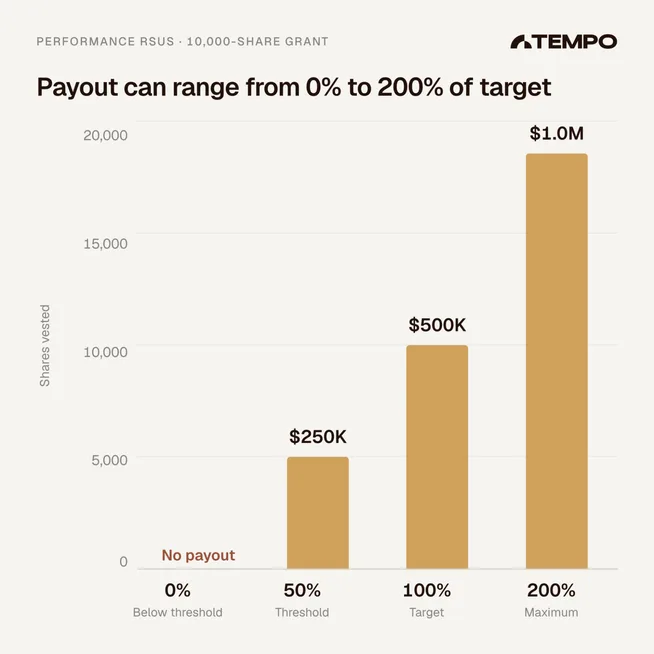
From a planning standpoint, this variability is significant. A time-based RSU vesting in Year 3 can be modeled with reasonable precision. A PRSU grant for the same period could deliver anywhere from nothing to $1 million in taxable income — a range that makes it nearly impossible to plan around without a scenario-based cash-flow model.
Because PRSUs can vest at anywhere from 0% to 200% of target, a robust cash-flow plan runs multiple scenarios — a base case, a downside, and an upside — so that spending, tax, and investment decisions remain sound across the full range of outcomes.
Tax Treatment: Both Types Vest as Ordinary Income
One point that surprises many executives: regardless of whether RSUs are time-based or performance-based, the value of the shares on the vesting date is taxed as ordinary income — subject to federal income tax, Social Security (up to the wage base), and Medicare taxes including the 0.9% additional Medicare tax for high earners. There is no preferential capital gains treatment at vesting. Any subsequent appreciation after vesting is taxed as a capital gain when the shares are eventually sold — with the holding period determining whether it qualifies as long-term or short-term.
This distinction makes the decision of when to sell post-vesting shares an important one. Holding for more than a year after vesting converts future appreciation to long-term capital gains, while selling immediately after vesting avoids market risk but forfeits that potential rate advantage.
Managing ISOs, NQSOs, and SARs
Executives often hold all three types of equity-based awards simultaneously, each with its own tax treatment, exercise mechanics, and planning window. Treating them as interchangeable is one of the most common and costly mistakes we see.
How to Think About ISOs
ISOs offer the most favorable tax treatment: if you meet the holding period requirements (two years from grant, one year from exercise), the spread is taxed at long-term capital gains rates rather than ordinary income. The tradeoff is AMT exposure at exercise, which requires careful multi-year modeling to avoid a surprise tax bill.
How to Think About NQSOs
NQSOs are simpler but less forgiving. The spread between strike price and fair market value at exercise is taxed immediately as ordinary income — often pushing executives into the top marginal bracket in the year of exercise. Timing and sizing exercises across multiple years is essential.
How to Think About SARs
SARs function like NQSOs economically but require no out-of-pocket payment to exercise. The appreciation is paid in cash or shares and taxed as ordinary income at settlement. Because SARs often vest on a schedule and expire if unexercised, they require proactive monitoring as part of any cash-flow model.
A cash-flow-based plan maps out time-based RSU vesting events, PRSU scenario ranges, ISO exercise windows, NQSO spread exposure, and SAR settlement timing across multiple years — so that each decision is made in the context of your full income picture, not in isolation.
Executive Deferred Compensation: Opportunity or Liability?
Executive deferred compensation plans are one of the most powerful and most misunderstood tools available to senior leaders. Used well, they function as a proactive tax planning lever. Used poorly, they create income spikes in the years you can least afford them.
The challenge is that deferred compensation elections are typically irrevocable. Once you've committed to a distribution schedule, you're locked in. That's why the structuring decision deserves careful, multi-year modeling — not a last-minute choice made in November.
A properly structured executive deferred compensation distribution — aligned with a year of lower ordinary income, perhaps early retirement, a sabbatical, or a gap between NQSO exercises and PRSU vesting events — can shift significant income out of the 37% bracket and into the 22% or 24% range. That difference on a $500,000 balance can represent $65,000 or more in lifetime tax savings.
We walk through the lump-sum-versus-structured-payout math in this guide to deferred compensation.
Tax Bracket Management: The Long Game
One of the most underutilized advantages available to executives is the ability to actively manage tax brackets across multiple years. Most people think of their bracket as something that happens to them. Proactive planning turns it into something you control.
Strategies like Net Unrealized Appreciation (NUA), NQSO exercise timing, ISO AMT planning, SAR settlement coordination, time-based RSU vesting management, and PRSU scenario planning all depend on coordinating income across multiple years. Without a forward-looking model, these decisions get made reactively — at tax time, under pressure, with limited options.
With proper planning, executives can intentionally "fill up" lower brackets in certain years — exercising ISOs in a low-income year to minimize AMT, realizing long-term gains on post-vesting RSU shares, executing Roth conversions, or accelerating executive deferred compensation distributions — while keeping other years clean for high-income events like large PRSU payouts or NQSO exercises.
Consider the example scenario below:
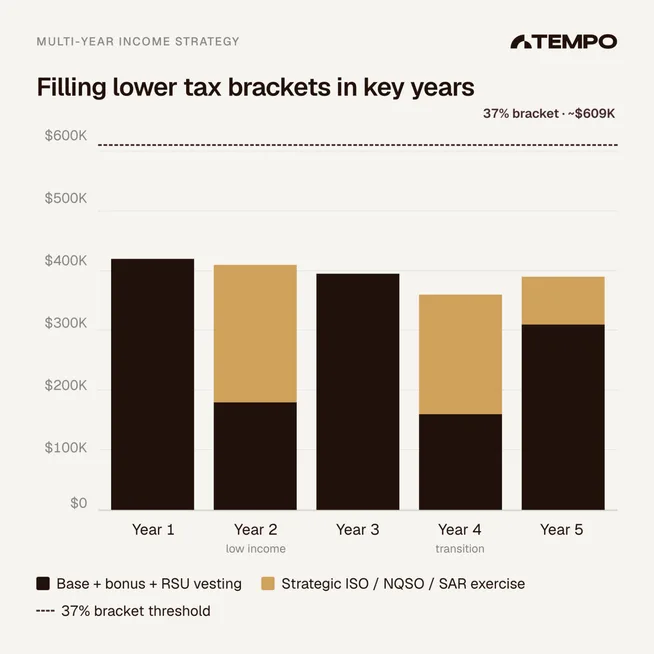
The result is a measurably lower lifetime tax rate.
A Total Integration Approach
True comprehensive planning for executives doesn't happen in a vacuum. The strategies described above — ISO AMT modeling, NQSO exercise timing, SAR coordination, PRSU scenario planning, RSU liquidation sequencing, and executive deferred compensation structuring — touch tax law, estate planning, insurance, and investment management simultaneously. Optimizing one area without coordinating the others can create unintended consequences.
This is why Tempo Wealth operates around a coordinated advisory model — integrating your CPA, estate attorney, and P&C insurance specialist as active collaborators rather than parallel voices working independently. Historically, this level of coordination was only accessible to ultra-high-net-worth families. Today's executives face equally complex decisions and deserve the same quality of oversight.
When every advisor is working from the same plan, every strategy — whether it's an ISO exercise, a deferred compensation election, or a concentrated stock diversification — gets vetted from multiple perspectives before execution.
The result is more proactive, more comprehensive, and frankly more confident planning. Not reactive tax prep. Not siloed investment management. A coordinated strategy that actually reflects the complexity of an executive's financial life.
At Tempo Wealth, our goal is to be a trusted resource with structured, principles-based planning for maximizing equity compensation — both during "business-as-usual" planning and in surprise moments like variable compensation and retirement income planning. If you'd like us to review your current holdings, model the after-tax impact, and build an equity-comp strategy aligned with your goals, reach out for a consultation. Call 440-568-3676 or email info@tempowealth.com.
Disclosures
Tempo Wealth, LLC ("Tempo") is a Registered Investment Advisor registered with the Securities and Exchange Commission (SEC). Registration as an investment adviser does not imply a certain level of skill or training, and the content of this communication has not been approved or verified by the United States Securities and Exchange Commission or by any state securities authority.
The information contained in this material is intended to provide general information about Tempo and its services. It is not intended to offer investment advice. Investment advice will only be given after a client engages our services by executing the appropriate investment services agreement. Information regarding investment products and services are provided solely to read about our investment philosophy and our strategies. You should not rely on any information provided on our web site in making investment decisions. Market data, articles and other content in this material are based on generally available information and are believed to be reliable. Tempo does not guarantee the accuracy of the information contained in this material. Tempo will provide all prospective clients with a copy of our current Form ADV, Part 2A (Disclosure Brochure) prior to commencing an advisory relationship. However, at any time, you can view our current Form ADV, Part 2A at adviserinfo.sec.gov. In addition, you can contact us to request a hardcopy.
This article discusses general planning considerations and does not take into account any individual's specific financial situation. Strategies discussed may not be appropriate for all investors. Examples are provided solely to illustrate common planning scenarios for executives that have some or all of these variable compensation plans.