
Progressive
Make your Progressive benefits work as one plan
Your Progressive comp package includes a lot to keep track of: RSUs that vest in thirds, a Gainshare bonus that swings with results, a 401(k) with a company stock fund and a Spillover account, and an executive deferred comp plan with a December deadline. The experienced team at Tempo Wealth helps Progressive employees build those benefits into a single strategy.
Prefer to talk it through? Match with an advisor →
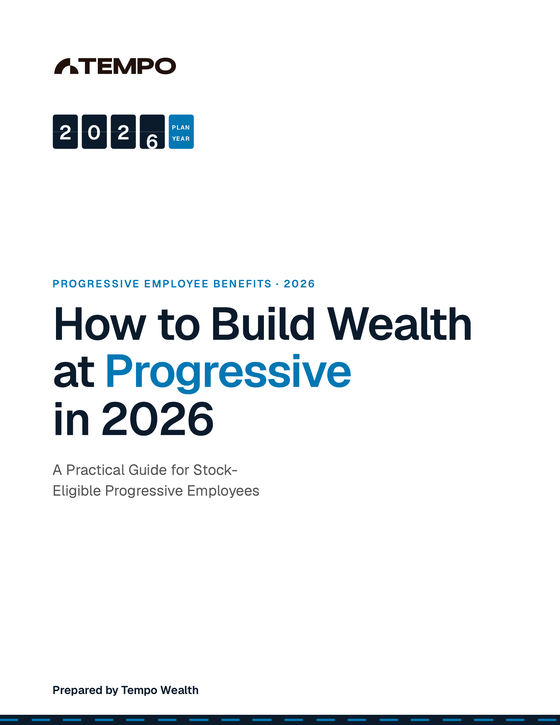
Free Guide
How to Build Wealth at Progressive in 2026
- RSUs, the Rule of 70, and the January vest
- The Spillover account and NUA on PGR stock
- EDCP elections and your payout schedule
Got it! You should be redirected momentarily. If not, click here to go directly to the download page.
Oops! Something went wrong while submitting the form.
Progressive's culture is built on measuring what matters and acting on it. Its benefits package rewards employees who do the same. The hard part is knowing how each piece fits into the overall puzzle.
Individuals are clients of the firm. They did not receive any compensation for their testimonial. To our knowledge, these clients have no material conflicts of interest arising from their relationship with Tempo Wealth. Testimonials may not be representative of the experience of other clients and are no guarantee of future performance or success. Past performance does not guarantee future results. Investing involves risk, including the potential loss of principal.
Where Progressive benefits get complicated
Progressive’s benefits bring decisions about cash flow, taxes and retirement timing. Several come together around year-end.
The December EDCP election
You choose a deferral percentage before you know what Gainshare will pay. That affects next year’s cash flow and future taxable income. Deferred RSUs also stay in Progressive stock until payout, and your payout election is difficult to change.
The Rule of 70 and your retirement date
Qualifying for the Rule of 70 is only part of the decision. You must stay through the end of a grant’s calendar year to keep it. Your retirement month also affects how much salary falls in the same tax year as accelerated RSU vesting.
RSU vesting and the withholding gap
January RSU vesting and dividend income can create a larger tax bill than expected. Employers commonly withhold federal tax on the vest at just 22%, which can fall below your actual rate. Reinvesting a dividend in a taxable account doesn’t remove the tax bill.
Progressive stock inside the 401(k)
A routine rollover can give up a tax option on your Progressive shares. Net Unrealized Appreciation (NUA) treatment may allow qualifying stock gains to be taxed at capital gains rates when sold. Whether it helps depends on your cost basis, tax rates, and how you take the distribution.

Sizing the EDCP deferral before December 31
We test next year’s cash needs at several Gainshare outcomes and include elections for newly granted RSUs. Awards already granted keep their existing elections.
Planning income after your last paycheck
We connect your EDCP payout schedule and savings with expected spending, including the gap before the first deferred compensation payment arrives.
Planning for the January vest and dividend
We estimate the gap between withholding and your likely tax bill, then plan how to cover it with cash set aside or estimated payments.
Reviewing your total Progressive stock exposure
We look across vested shares, the 401(k) Stock Fund and deferred RSUs to see how much of your wealth depends on Progressive, then weigh diversification alongside taxes and your goals.
Scenarios we plan for at Progressive
These questions come up at different points in a Progressive career, from an annual election to the decision to retire.
Time-Sensitive · December Election
“The EDCP window opens in December. How much of next year's Gainshare should I defer, and on what schedule?”
A deferral that fits at one Gainshare outcome may leave too little cash at another. The decision also commits money to a future payout schedule, so today’s spending needs and retirement income need to be considered together.
How Tempo approaches it: We test the deferral at Gainshare factors of 0.5, 1.0 and 2.0, then compare payout schedules against your expected retirement income, tax brackets and state of residence.
Retirement Window · 55+
“I’ve built up Progressive stock in my 401(k). When I leave at 57, should I evaluate NUA before rolling it over?”
After years in the Stock Fund, your shares may have a cost basis well below their value. The question is whether NUA’s tax treatment justifies the upfront tax on that basis, compared with keeping the money in an IRA.
How Tempo approaches it: We compare both routes using your share basis, likely tax rates and other retirement income, then review the distribution steps before any rollover paperwork is signed.
Retirement Window · Rule of 70
“I hit the Rule of 70 next year. When in the year should I plan to leave?”
Once the grant-year requirement is met, moving retirement into a new tax year can change how much salary is taxed alongside accelerated time-based RSUs. Gainshare and deferred compensation payments also affect the comparison.
How Tempo approaches it: We compare candidate months on a single tax-year view, including Gainshare, EDCP timing and any PTO payout, so you can weigh the dates with the numbers in front of you.
Common Starting Point
“My RSUs vested and the annual dividend arrived. Should I keep reinvesting in Progressive?”
New shares and reinvested dividends can make Progressive a larger part of your portfolio than you intended. You may also need some of that cash to cover taxes.
How Tempo approaches it: We review your total Progressive holdings, estimate the cash needed for taxes, and weigh reinvesting against diversifying or funding other goals.
Progressive NUA calculator
Enter your shares, cost basis and tax rates to compare NUA with a rollover.
Tax assumptions
Position value
Unrealized appreciation
Estimated tax, ordinary IRA rollover route
Estimated tax, NUA route
- Ordinary income tax on the cost basis, due now
- Capital gains tax on the appreciation, at sale
- 10% early-distribution penalty on the cost basis
Potential difference
An NUA election only applies when the stock leaves the plan as a lump-sum, in-kind distribution after a qualifying event.
There is no appreciation at these inputs.
This tool is educational and simplified. It compares a single lump-sum distribution at the rates you enter, assumes the shares are sold in retirement, and reduces the age-based early-distribution rules to one toggle. It ignores growth after distribution and partial NUA elections. Results are simplified estimates, depend on assumptions entered by the user, and do not predict actual tax consequences. It is not tax or investment advice. Talk to your advisor and tax professional before making any election.
FAQs: Progressive benefits
Does Progressive match 401(k) contributions?
Yes. Progressive matches dollar for dollar up to 6% of eligible pay, with a $12,000 annual cap for highly compensated employees. Gainshare and bonuses don’t count. The match is calculated each paycheck, so periods without contributions earn no match.
How do Progressive RSUs vest?
Time-based RSUs vest one-third each January in years three, four and five, with nothing vesting in the first two years. Senior executives and officers also receive performance RSUs that vest after three years at 0 to 2.5 times target. Your award agreement controls.
What is the Rule of 70 at Progressive?
You qualify at 55 with at least 15 years of service, or 60 with at least 10. You must stay through the end of an award’s grant year. Eligible time-based awards then vest at retirement, while performance awards remain subject to their performance conditions.
What is the Spillover account?
Spillover lets you make after-tax 401(k) contributions once you reach the pre-tax and Roth deferral limit. The plan permits in-plan Roth conversions and in-service withdrawals for Roth IRA rollovers. Available room depends on IRS limits, company contributions and plan testing. Earnings are taxable at conversion or distribution; qualified Roth withdrawals are tax-free.
Can I use NUA on Progressive stock in my 401(k)?
Possibly. A qualifying lump-sum distribution lets you take Stock Fund shares out of the plan, pay ordinary income tax on their cost basis, and generally defer tax on the appreciation until sale. Rolling the shares into an IRA gives up NUA treatment. The better choice depends on your basis and tax rates.
How does the Executive Deferred Compensation Plan work?
Executives with a Gainshare target of at least 35%, or committee designation, elect each December to defer next year’s Gainshare and newly granted RSUs. Gainshare deferrals start at 10%. Deferred RSUs stay in Progressive stock; Gainshare has investment choices. Payouts are a lump sum or installments after separation or a fixed deferral period. Separation payments typically start six months and one day later. The balance is an unsecured promise from Progressive.
Keep going on Progressive
From the BlogHow a surprise dividend changed tax calculations for Progressive shareholdersFrom the BlogHow executives can use NUA to keep more of their company stock gainsFrom the BlogDeferred compensation: the tax timing tool most executives underuse
We work with stock-eligible employees at many companies. See how we specialize →
The content regarding Progressive employee benefits, including the 401(k) and Spillover account, RSUs and the Rule of 70, the Executive Deferred Compensation Plan, and NUA strategies, is provided for educational purposes only and is not tax, legal, or investment advice. Plan terms change; always confirm details in Progressive's official plan documents. Tempo Wealth is not affiliated with or endorsed by Progressive. All company trademarks are the property of their respective owners. Last reviewed September 2026.