
Microsoft
Do you have a complete picture of your Microsoft equity?
Between quarterly stock payouts, the ESPP, deferred comp elections and a 401(k) with room for after-tax savings, senior leaders at Microsoft are asked to make complex planning decisions that often depend on one another. Tempo Wealth helps put those decisions into a unified, tax-efficient strategy.
Prefer to talk it through? Match with an advisor →
Free Guide
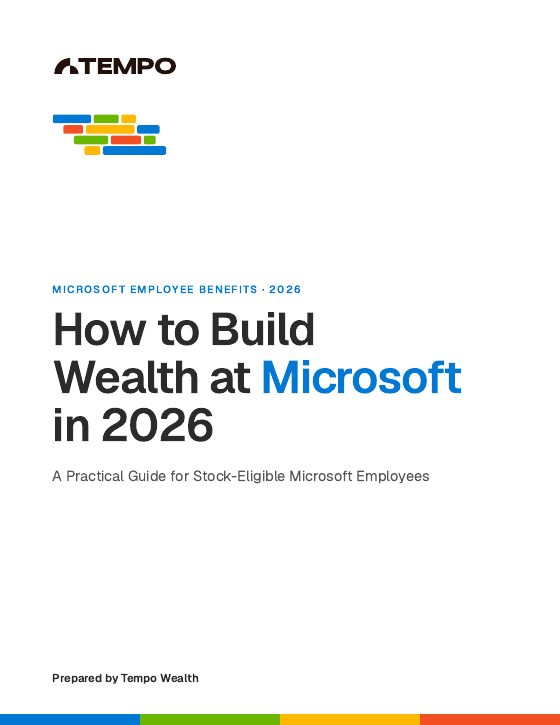
How to Build Wealth at Microsoft in 2026
- How stock awards affect taxes
- Deferred comp and other strategies
- How to know when you can retire
Got it! You should be redirected momentarily. If not, click here to go directly to the download page.
Oops! Something went wrong while submitting the form.
Microsoft grants a new stock award every year. Over a career, that equity can pile up. Deciding how much to keep and when to sell takes a plan.
Where Microsoft Equity Gets Complicated
Most of these rules turn on a date, such as an August 31 grant, a deferral window, or your last day at Microsoft.
How age and years of service change your awards
Microsoft's 55 and 15 rule can let annual awards keep vesting after you leave at 55 with 15 years of service, or at 65. Whether it applies depends on your hire date and each award's age, so a few days' difference in your last day can decide whether you keep a full year's award.
The withholding gap on each vest
Each vest counts as wage income at that day's share price. Microsoft holds back shares for tax, but flat-rate federal withholding can fall short of your bracket. A shortfall may call for estimated payments during the year.
Deferred comp choices that are hard to undo
At level 67 and above, the Deferred Compensation Plan lets you defer up to 75% of salary and 100% of your bonus. You pick the payout schedule when you elect, but changing it later pushes payment back at least five years.
The after-tax 401(k) and its ceiling
For 2026, the 401(k) accepts up to $35,250 of after-tax money on top of your deferrals and match, with daily conversion to Roth. All your elections together are capped at 65% of each paycheck's salary or bonus.

Building a calendar of vests and payouts
We map each grant's remaining vest dates, plus Employee Stock Purchase Plan (ESPP) purchases and any deferred comp payments, so you can see what income arrives when and what tax it may bring.
Deciding how much Microsoft stock to hold
We add up your vested shares, ESPP stock and any older 401(k) stock, compare that with the rest of your net worth, and weigh selling against taxes and your goals.
Planning income after your last paycheck
We line up deferred comp payments, savings withdrawals and Social Security against what you expect to spend, including the tax picture if you move away from Washington.
Checking insurance against your full pay
We compare life and disability coverage, which follow base pay and bonus, with what your household relies on, and work through estate questions in the same plan.
Scenarios We Plan for at Microsoft
Each scenario starts with a question about one Microsoft decision and shows how we would work through it.
Retirement Window · 55+
“I'll be 55 with 15 years at Microsoft next year. If I leave then, what happens to my unvested stock?”
Annual awards at least a year old can keep vesting after a qualifying retirement, if you were hired before August 1, 2023, sign a release and meet the conduct terms. Newer awards end when you leave.
How Tempo approaches it: We set each grant against the dates you're considering and show what would keep vesting, what you'd forfeit and the tax years each date creates.
Common Starting Point
“A big part of my pay vests in Microsoft stock. Is the tax withheld at each vest enough?”
Each vest is wage income. Microsoft holds back shares for tax, but flat-rate withholding may not match your bracket, and with grants vesting through the year a shortfall can build.
How Tempo approaches it: We work with your tax professional to estimate the gap for the year ahead from your full income and plan for it with added withholding where available, estimated payments or cash set aside.
Time-Sensitive · November
“I'm level 67 and the November deferral window is coming. How much salary should I defer, and when should it pay out?”
You choose the payout form and start date when you elect, and changing them later pushes payment back at least five years. Deferred salary also generally drops out of the pay your 401(k) draws on.
How Tempo approaches it: We size the deferral against next year's cash needs and your 401(k) plans, then match the payout schedule to the years after you leave and where you expect to live.
Concentration
“Most of what I own is Microsoft stock. How do I reduce that without a big tax bill, and does it matter if I retire outside Washington?”
The IRS taxes a sale of shares held over a year as a capital gain, and Washington taxes large long-term gains. A move to a state with an income tax can change the cost of selling later.
How Tempo approaches it: We set a selling pace across tax years, weigh gifts of shares to a donor-advised fund and harvested losses, and time sales around any planned move.
Microsoft RSU calculator
Enter the Restricted Stock Units (RSUs) vesting, the share price and a federal rate to compare withholding with an estimate at your rate.
This model assumes no other supplemental wages this year and the flat withholding method: 22% on the first $1,000,000 of this vest and 37% above that.
Income from this vest
Blended withholding rate
Estimated federal tax at the selected rate
Modeled federal withholding at vest
Potential gap
Your employer may withhold differently; the rate and method applied appear on your vest confirmation and pay records.
This educational tool uses the full share count before tax withholding, assumes shares settle at vest and models federal income-tax withholding using the flat supplemental-wage method. It assumes no other supplemental wages during the calendar year. The estimate applies one federal rate to the entire vest; actual income can cross tax brackets. State and local income taxes, Social Security, Medicare, other income, deductions and credits are excluded. Employer withholding methods and actual tax can differ. Results are estimates, not tax advice or a payment recommendation.
FAQs: Microsoft Benefits
How do Microsoft stock awards vest?
Annual stock awards are granted each August 31 and generally vest over four or five years, a portion at each vest date, as long as you're still employed. On-hire awards and executive awards follow their own schedules. Your award agreement sets the dates.
What is Microsoft's 55 and 15 rule?
If your award agreement includes it, leaving at 65, or at 55 with 15 years of continuous service, keeps annual awards at least a year old vesting on schedule. It covers employees hired before August 1, 2023, and requires a release and no misconduct for a year after you leave.
Does Microsoft match 401(k) contributions?
Yes. Microsoft matches 50% of pre-tax and Roth contributions up to the IRS deferral limit, so $12,250 on $24,500 for 2026. The match vests immediately. Catch-up and after-tax contributions aren't matched, and all your elections together can't exceed 65% of each paycheck's eligible pay.
Can I do a mega backdoor Roth at Microsoft?
The 401(k) accepts after-tax contributions, up to $35,250 for 2026, and you can convert them to Roth inside the plan, including a daily automatic conversion. While you're working and under 59½, you can also move after-tax money to a Roth IRA. The IRS taxes any earnings you convert.
Who can join Microsoft's Deferred Compensation Plan?
U.S. employees at stock level 67 and above. You can defer up to 75% of base salary and 100% of your annual bonus, and choose a lump sum or 3 to 15 annual installments when you elect. Balances are unsecured, and Microsoft adds nothing to them.
Can I use NUA on Microsoft stock in my 401(k)?
Possibly, if you still hold Microsoft stock bought in the plan before 2016, when new money into it stopped. The plan can distribute the stock as shares. With a qualifying lump-sum distribution, you pay ordinary income tax on the cost basis, and Net Unrealized Appreciation (NUA) may let the growth be taxed at long-term capital gains rates when sold.
Does Washington tax my Microsoft stock?
As of 2026, Washington doesn't have an individual income tax, so vests carry federal tax but no state income tax. It does tax long-term capital gains, and a tax on income above $1 million is set to start in 2028.
Keep going on Microsoft
From the BlogManaging restricted stock units for tax planningFrom the BlogDeferred compensation: the tax timing tool most executives underuseFrom the BlogHow executives should think about their ESPP
We work with stock-eligible employees at many companies. See how we specialize →
The content regarding Microsoft employee benefits, including stock awards, the employee stock purchase plan, the Deferred Compensation Plan, the 401(k), and NUA strategies, is provided for educational purposes only and is not tax, legal, or investment advice. Plan terms change; always confirm details in Microsoft's official plan documents and your own award agreements. Tempo Wealth is not affiliated with or endorsed by Microsoft. All company trademarks are the property of their respective owners. Tempo Wealth is not affiliated with or endorsed by Microsoft. All company trademarks are the property of their respective owners. Last reviewed November 2026.