
RPM International
Do your RPM benefits and awards work together in one plan?
RPM pays its leaders in SARs, restricted stock, and other types of awards (plus standard comp and benefits). The challenge is understanding how each piece works with the others, especially as you plan for retirement. Tempo Wealth helps senior leaders at RPM build a unified strategy around their benefits and compensation.
Prefer to talk it through? Match with an advisor →
Free Guide
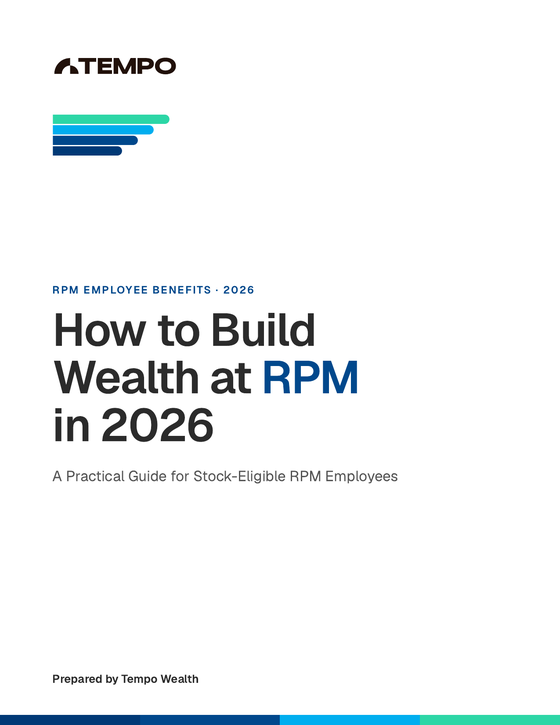
How to Build Wealth at RPM in 2026
- What happens to your RPM equity at 55
- SARs, PERS, SERP shares and PSUs
- Deferred comp, the pension and NUA
Got it! You should be redirected momentarily. If not, click here to go directly to the download page.
Oops! Something went wrong while submitting the form.
RPM has raised its dividend for over 50 years in a row. Its compensation package rewards leaders for their commitment, too. The hard part is knowing what each award does, and how it fits into a larger plan.
Where RPM equity gets complicated
RPM's awards each follow their own rules, and most of the differences show up when you leave.
Resigning with vested SARs
If you resign before qualifying for Normal Retirement at 55 with five years of service, the right to exercise even your vested Stock Appreciation Rights (SARs) ends right away. If you're weighing another role, the timing of your notice can change what you keep.
The 55 line and the competitor clause
At 55 with five years of service, most awards change. SARs generally stay exercisable for their full term and Performance-Earned Restricted Stock (PERS) vest, but Performance Stock Units (PSUs) and unexercised SARs carry specific conditions.
SERP shares and the five-year count
Each SERP grant has its own release date, so retiring early can leave your newest grants behind. A grant generally stays restricted until you're 55 and it's about five years old. Leave before 65 and any grant that hasn't reached that point is forfeited.
Minimum withholding on SARs and stock awards
RPM withholds at the minimum required rate when you exercise SARs or when restricted stock vests. That's typically a flat 22% federal rate on the first $1 million of supplemental wages, which can fall short of your bracket and leave a bill at tax time.

Mapping every grant by year
We list your SARs, restricted stock, PSUs, deferred compensation and pension by the year each one pays out or can be exercised, so the whole picture fits on one page.
Sizing your RPM stock position
Your salary, your awards and part of your savings may depend on RPM. We look at your total exposure, including the 401(k) stock fund, and weigh diversification against taxes and your goals.
Planning income for retirement
We line up pension options, deferred compensation payouts and savings against what you expect to spend, so income arrives on a schedule that matches your needs.
Coordinating tax and estate decisions
We work through tax, insurance and estate questions in the same plan, so an exercise or a payout election fits the rest of your finances.
Scenarios we plan for at RPM
These questions come up at different points in an RPM career, from a year-end election to the decision to retire.
Retirement Window · 55+
“I turn 55 next year with more than five years at RPM. What happens to my SARs, PSUs and restricted stock if I retire?”
Normal Retirement changes each award differently. PERS vest, SARs stay exercisable, PSUs wait for RPM's results, and SERP grants follow their own five-year count. The competitor clause stays with PSUs and SARs after you leave.
How Tempo approaches it: We lay out what retiring on a given date would mean for each grant, then compare dates and the tax years they create.
Time-Sensitive
“I've been offered a role at another company. What should I do with my vested SARs before I give notice?”
A resignation before Normal Retirement ends the right to exercise vested SARs. Exercising first turns the spread into wage income this year, with withholding that may fall short of your bracket.
How Tempo approaches it: We estimate the tax on exercising before you leave, weigh it against what you'd give up, and plan cash for any gap between withholding and your actual tax.
Time-Sensitive · Before January 1
“My deferred comp election for next year's salary is due before January. How much should I defer, and how will it pay out?”
The plan pays a lump sum after you leave unless you retire at 55 with five years of service and your balance is above the IRS limit. Changing the payout form later delays it at least five years.
How Tempo approaches it: We size the deferral against next year's cash needs and match the payout choice to your expected retirement income and where you plan to live.
Retirement Window
“Part of my 401(k) sits in the RPM stock fund. Should I evaluate Net Unrealized Appreciation (NUA) before I roll it over?”
If the plan lets you take RPM stock fund shares out in kind, NUA may let the growth be taxed at capital gains rates. A routine rollover gives that option up.
How Tempo approaches it: We compare NUA with a rollover using your basis and tax rates, then confirm the distribution steps with the plan before any paperwork.
RPM SAR exercise calculator
Enter your vested SARs, grant price and share price to compare federal withholding with an estimate at your tax rate.
This model assumes no other supplemental wages this year and the flat withholding method: 22% on the first $1,000,000 of this exercise and 37% above that.
Income from this exercise (the spread)
Blended withholding rate
Estimated federal tax at the selected rate
Modeled federal withholding at exercise
Potential gap
Your employer may withhold differently; the rate and method applied appear on your exercise confirmation and pay records.
This educational tool models exercising stock-settled stock appreciation rights (SARs) in a single transaction. It treats the full spread (share price minus grant price, times the SARs exercised) as ordinary income and models federal income-tax withholding using the flat supplemental-wage method. It assumes no other supplemental wages during the calendar year. The estimate applies one federal rate to the entire spread; actual income can cross tax brackets. State and local income taxes, Social Security, Medicare, other income, deductions and credits are excluded. Employer withholding methods and actual tax can differ. Results are simplified estimates, depend on assumptions entered by the user, and do not predict actual tax consequences. They are not tax advice or a recommendation to exercise.
FAQs: RPM benefits
Does RPM match 401(k) contributions?
Yes. RPM matches 100% of the first 3% of pay you contribute and 50% of the next 2%, up to 4% of pay, and the match vests immediately. New employees are enrolled automatically at 3%, which earns a 3% match. Contributing 5% earns the full 4%.
How do RPM SARs work?
Stock-settled Stock Appreciation Rights (SARs) pay the rise in RPM's share price above the grant price, in RPM shares. They become exercisable 25% a year over four years and last 10 years. The gain is wage income when you exercise, and RPM withholds at the minimum required rate. Your award agreement controls the specifics.
What happens to my RPM equity if I retire at 55?
Under RPM's award forms, Normal Retirement means leaving at 55 or older with five consecutive years of service, not for cause. Stock Appreciation Rights (SARs) generally stay exercisable for their term, Performance-Earned Restricted Stock (PERS) vests, and Performance Stock Units (PSUs) vest on results, subject to a competitor clause. SERP grants follow their own lapse dates.
Does RPM offer a pension?
Yes. The RPM International Inc. Retirement Plan is company-paid and covers most U.S. employees who aren't in a union. It vests after five years and bases the benefit on your highest 60 months of pay within the last 120. At retirement you can take monthly income or a lump sum of its full value.
How does RPM's Deferred Compensation Plan pay out?
Employees RPM selects can defer up to 90% of salary and bonus. The plan pays a lump sum after you leave, unless you leave in Retirement with a balance above the IRS elective deferral limit, when you can elect up to 10 annual installments. Most participants wait until the seventh month after leaving.
Can I use NUA on RPM stock in my 401(k)?
Possibly. The 401(k) offers an RPM stock fund, capped at 20% of each contribution. If the plan allows a qualifying lump-sum distribution of the shares in kind, you pay ordinary income tax on their cost basis, and Net Unrealized Appreciation (NUA) may let the growth be taxed at long-term capital gains rates when you sell. Rolling the shares to an IRA gives up NUA.
Keep going on RPM International
From the BlogDeferred compensation: the tax timing tool most executives underuseFrom the BlogHow executives can use NUA to keep more of their company stock gainsFrom the BlogWhen your equity compensation starts requiring a plan
We work with stock-eligible employees at many companies. See how we specialize →
The content regarding RPM International employee benefits, including SARs, PERS, SERP restricted stock, PSUs, the Deferred Compensation Plan, the pension plan, the 401(k), and NUA strategies, is provided for educational purposes only and is not tax, legal, or investment advice. Plan terms change; always confirm details in RPM's official plan documents and your own award agreements. Tempo Wealth is not affiliated with or endorsed by RPM International. All company trademarks are the property of their respective owners. Tempo Wealth is not affiliated with or endorsed by RPM International. All company trademarks are the property of their respective owners. Last reviewed November 2026.